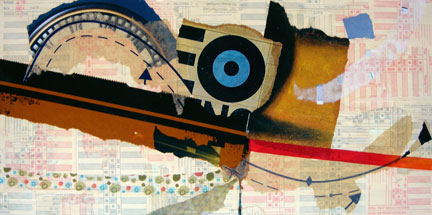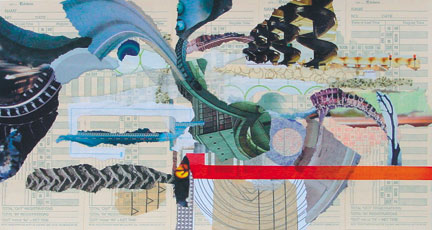
First in the latest series of Time and Balance experiments, this collage is 10 x 20 x 1", composed of contemporary papers, recycled imagery, and ribbon on a cradled wood panel. This piece uses the timecards as backgrounds, described in previous post.
Time and balance series
This series was inspired by "Timeline," a collage that came together almost effortlessly and out of the blue— it simply needed to BE. Timeline was originally shown in 2002 as part of an International Collage Exhibition at Kansas State University, curated by Lynda Andrus.
The work is a meditation of sorts on the passage of time, both linear and cyclical, and the ever-present search/struggle for balance in my life. An ongoing element in this series is the timecard, used in some workplaces for logging time on the job, making up most of the background areas.
My recent show included five pieces from the time and balance series. I'll post individual images soon so that details are more visible.

Synthetic cubism
My website was recently added to the collageart.org directory of collage artists and collage-related sites. It's great to be included among so many amazing collage artists. This resource is worth some serious web-surfing to see the range of work being done in the collage medium.
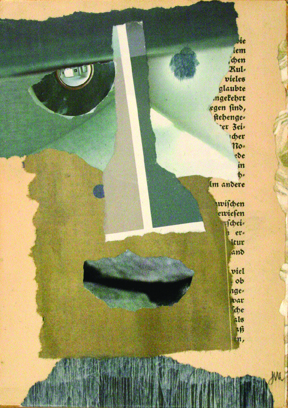
Painter and collage artist Jonathan Talbot wrote about my work, "The collages of Janice McDonald are inspired, in part, by synthetic cubism and other 20th Century art movements." I'd never assessed my work quite that way but found his comment appropriate to much, if not all, of my work. (I was fortunate to study with Jonathan at his studio in 2001 and often recommend his book, "Collage: A New Approach.")I see cubism most obviously influencing my figurative work like collages from the Foundling Series. This is number 19 in the series of small works, measuring 7 x 5."
Background patterns
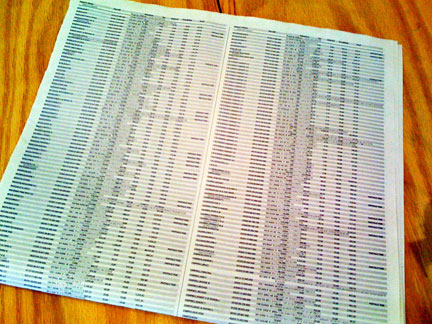
I love patterns of all kinds and often use them as elements in my collages. Here is a photo of the newspaper tax lien listings that make up the background of "Juggling." The tabular format of the type creates a random pattern and every other line has a shaded stripe. The type is about 4 point so you can only read it if you are really close, just names and numbers. The inside of safety envelopes (usually from bills)— along with bits of time cards, to-do lists, and order forms— have also made their way into my work from time to time. I'm always on the lookout for new elements to stash in the studio for use "someday." This explains the chaotic but bountiful state of my studio!